True Sarsaparilla vs Indian Sarsaparilla is a botanical comparison, not a choice between two regional varieties of the same species. Products described as Jamaican, Mexican, or Central American sarsaparilla commonly use plants from the genus Smilax. Indian sarsaparilla usually refers to Hemidesmus indicus, a separate species from another botanical family.
The shared common name can make powders, capsules, teas, and extracts look interchangeable when they are not. Their taxonomy, geographic origin, root characteristics, chemical profiles, and traditional contexts differ. Secrets Of The Tribe treats the scientific name as the primary identity marker whenever a marketplace listing uses the word sarsaparilla.
This guide explains what each name means, which botanical name to look for, and why research on one plant should not automatically be applied to the other.
Are true sarsaparilla and Indian sarsaparilla the same plant?
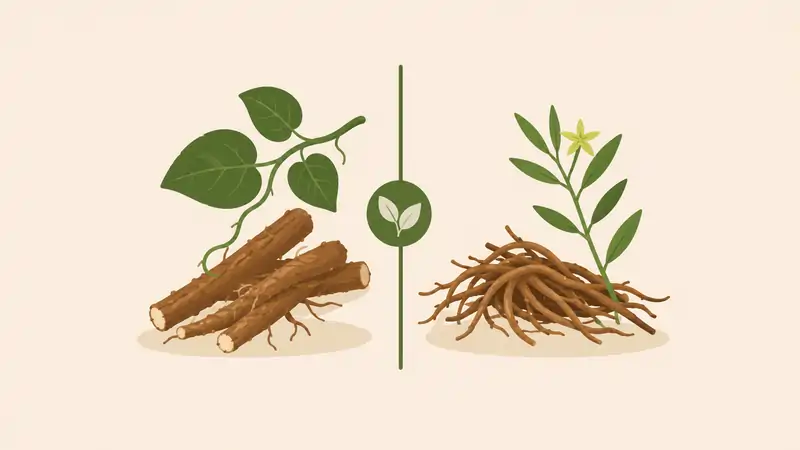
No. True sarsaparilla and Indian sarsaparilla are different botanical ingredients.
Traditional commercial sarsaparilla from the Americas is associated with several tropical species of Smilax. Examples include Smilax ornata and Smilax officinalis. These plants belong to the family Smilacaceae.
Indian sarsaparilla is Hemidesmus indicus. It belongs to the family Apocynaceae. Kew Plants of the World Online accepts this species and places it in the genus Hemidesmus.
The two ingredients share a common name because their roots have been used in overlapping commercial and traditional contexts. That naming history does not make them taxonomically equivalent.
| Feature | True sarsaparilla | Indian sarsaparilla |
|---|---|---|
| Typical botanical identity | One of several Smilax species | Hemidesmus indicus |
| Plant family | Smilacaceae | Apocynaceae |
| General native region | Tropical Americas, depending on species | Indian subcontinent to parts of Southeast Asia |
| Growth form | Climbing or scrambling plants | Climbing, trailing, or semi-erect shrub |
| Commercial material | Usually underground parts described as root or rhizome | Usually aromatic root |
| Interchangeable? | No | No |
What does true sarsaparilla mean?
True sarsaparilla is an informal commercial term rather than one universally accepted species name. It generally refers to root material from tropical plants in the genus Smilax.
Kew notes that the botanical material historically known as sarsaparilla came from the roots of various tropical Smilax species. This means that even within true sarsaparilla, the exact species can differ.
Names found in trade may include:
- Jamaican sarsaparilla.
- Honduran sarsaparilla.
- Mexican sarsaparilla.
- Central American sarsaparilla.
- American sarsaparilla.
- Sarsaparilla root.
These geographic names are not always reliable species identifiers. A seller may use a historical trade name, a sourcing region, or a broad marketing category.
Common Smilax species in sarsaparilla products
Smilax ornata is an accepted species native from parts of Mexico through Central America. Older literature and trade records may use the synonym Smilax regelii.
Smilax officinalis is another accepted species associated with sarsaparilla. Its native range extends from Honduras into parts of northwestern South America.
Other Smilax species may also be sold under local or commercial sarsaparilla names. A label that states only “sarsaparilla root” leaves the exact species unclear.
What is Indian sarsaparilla?
Indian sarsaparilla is the common name for Hemidesmus indicus. It is also known by regional names such as anantamul, anantmool, nannari, naruneendi, and sugandhi.
Kew accepts Hemidesmus indicus and classifies it in Apocynaceae. The species is native from the Indian subcontinent through parts of Indo-China and Peninsular Malaysia.
Its root is known for a more noticeable aromatic character than many plain Smilax root powders. Descriptions may compare its aroma with vanilla, tonka, or sweet woody notes. Sensory descriptions vary with processing and storage.
Indian sarsaparilla has its own place in South Asian botanical traditions and beverages. That history does not make it a geographic type of Smilax.
Why it is sometimes called false sarsaparilla
Some references use the name false sarsaparilla because Hemidesmus indicus was used as an alternative or substitute for sarsaparilla roots from the genus Smilax.
The term false does not mean the plant is counterfeit. It means that the plant shares a commercial common name while belonging to another taxonomic group.
Why did two unrelated plants receive the same common name?
Common names develop through trade, local languages, sensory resemblance, preparation methods, and substitution. They do not follow the strict naming system used in botanical taxonomy.
When imported Smilax root was unavailable or expensive, another aromatic root could enter local trade under a familiar name. Over time, the replacement name could become established even when the species was unrelated.
The word sarsaparilla therefore functions in several ways:
- As a broad name for roots from tropical Smilax species.
- As a common name for Hemidesmus indicus.
- As a flavor or beverage name.
- As a marketplace search term.
Only the first two describe botanical ingredients, and they describe different plants.
Which scientific name should appear on the package?
A clear package should identify the genus and species, followed by the plant part. The expected name depends on which ingredient the manufacturer intends to sell.
| Label wording | Likely identity | Clarity |
|---|---|---|
| Smilax ornata root | Central American Smilax sarsaparilla | Specific |
| Smilax officinalis root | Another recognized Smilax sarsaparilla | Specific |
| Hemidesmus indicus root | Indian sarsaparilla | Specific |
| Indian sarsaparilla root | Probably Hemidesmus indicus | Scientific name still needed |
| Sarsaparilla root | Could refer to more than one species | Insufficient for precise identification |
| Sarsaparilla extract blend | Species and proportions may be unclear | Requires full ingredient review |
For dietary supplements sold in the United States, the Supplement Facts panel must identify the plant part used. Botanical labeling may also use a standardized common name and provide the Latin binomial.
The editorial practice at Secrets Of The Tribe is to preserve the name printed on the package while adding the verified scientific identity separately. This prevents a common name from silently replacing the actual ingredient record.
Can Indian sarsaparilla replace Smilax sarsaparilla?
No. Indian sarsaparilla should not automatically replace a Smilax ingredient in a supplement, tea, extract, or research summary.
The products may differ in:
- Botanical family.
- Root anatomy.
- Natural chemical profile.
- Aroma and flavor.
- Extraction behavior.
- Traditional preparation.
- Quality specifications.
- Safety data.
- Research relevance.
A manufacturer reformulating from one plant to the other would be changing the botanical ingredient, not merely changing the country of origin.
Equal milligrams do not make them equivalent
Five hundred milligrams of Hemidesmus indicus root powder is not equivalent to five hundred milligrams of Smilax ornata root powder. The weights may match, but the plant material does not.
Extract ratios also cannot bridge the taxonomic difference. A 10:1 extract from one species does not become comparable to a 10:1 extract from another species simply because the ratios match.
Can research on Indian sarsaparilla apply to Smilax?
Not automatically. Research findings apply most directly to the species, plant part, preparation, dose, and route that researchers tested.
A study using an aqueous extract of Hemidesmus indicus root does not directly test Smilax ornata, Smilax officinalis, or another Smilax species.
Before connecting a study to a product, match:
- The complete botanical name.
- The plant part.
- The extraction solvent.
- The extract ratio or concentration.
- The route of use.
- The tested amount.
- The product formulation.
- The study population or model.
Using the common name sarsaparilla in a research summary can hide a species mismatch. Scientific names should appear whenever botanical evidence is discussed.
Can appearance, smell, or taste identify the species?
Not reliably. Sensory differences can provide clues, but they cannot confirm a commercial powder or extract on their own.
Hemidesmus indicus root may have a sweeter and more aromatic profile. Smilax root material may seem earthier, woodier, starchier, or more neutral. Processing can change all of these characteristics.
Powders may look similar after drying and milling. Color can shift with harvest age, oxidation, storage, particle size, and lighting. Added flavors can also imitate an expected aroma.
Reliable identification requires supplier documentation and an appropriate botanical identity method. Taste alone cannot establish species, purity, concentration, or safety.
Why do online listings make the confusion worse?
Marketplace titles often prioritize short search terms. A seller may place “sarsaparilla” at the start of a listing and move the scientific name into an image, description, or hidden specification.
Other common problems include:
- Using Indian and Jamaican sarsaparilla as synonyms.
- Showing photographs of the wrong plant.
- Copying descriptions from another supplier.
- Listing several scientific names for one ingredient.
- Omitting the plant part.
- Using only a geographic trade name.
- Confusing a beverage flavor with a botanical species.
A product title can help you find a listing. It should not be treated as final proof of botanical identity.
Sarsaparilla Botanical Identity Checklist
Use this checklist before buying a product labeled true, Jamaican, Mexican, American, or Indian sarsaparilla. It helps determine whether the package contains a Smilax species or Hemidesmus indicus.
Find the complete scientific name
Look for both genus and species. The word sarsaparilla alone is not specific enough.
Check the genus first
Smilax indicates true sarsaparilla in the traditional American trade sense. Hemidesmus indicates Indian sarsaparilla.
Confirm the plant part
Look for root, rhizome, root and rhizome, or another declared part. Do not assume all underground materials are equivalent.
Identify powder or extract
Determine whether the product contains milled root or a processed extract with a stated solvent or ratio.
Review the geographic name cautiously
Jamaican, Mexican, Honduran, and Indian are trade or regional names. They should not replace the botanical identity.
Read the entire ingredient panel
Check whether the product contains one species, several roots, flavors, fillers, or a proprietary blend.
Match research by species
Do not apply a study on Hemidesmus indicus to a Smilax product or the reverse.
Ignore appearance as proof
Powder color, root shape, smell, and taste cannot confirm an unknown commercial ingredient by themselves.
Ask when the species is missing
Contact the manufacturer for the botanical name and plant-part specification rather than guessing.
Does one type have a stronger flavor?
Indian sarsaparilla is often described as more aromatic, with sweet, vanilla-like, or coumarin-like notes. Smilax root products may taste more earthy, woody, bland, bitter, or mildly sweet.
These are general sensory patterns, not fixed rules. Extraction, storage, blending, and flavor additions can change the result.
A stronger aroma does not prove that the product is more concentrated or higher quality. A mild-smelling Smilax powder may still match its botanical specification, while a strongly flavored product may contain added aromatics.
Do the two plants have the same safety profile?
No. Their safety profiles should not be assumed to match because they are different species with different chemical compositions.
Safety can also vary with:
- Plant part.
- Preparation type.
- Extract concentration.
- Serving amount.
- Other ingredients.
- Medication use.
- Pregnancy or breastfeeding.
- Age and existing health conditions.
Traditional use does not establish that every concentrated extract is suitable for every person. A qualified healthcare professional can assess individual factors and possible interactions.
This article explains botanical identity. It does not recommend using either ingredient or selecting a serving amount.
FAQ
Is Indian sarsaparilla the same as true sarsaparilla?
No. Indian sarsaparilla is Hemidesmus indicus, while true sarsaparilla usually comes from species in the genus Smilax.
What is the scientific name of Indian sarsaparilla?
The accepted scientific name is Hemidesmus indicus.
What is the scientific name of true sarsaparilla?
True sarsaparilla can refer to several Smilax species, including Smilax ornata and Smilax officinalis.
Is Jamaican sarsaparilla a Smilax plant?
It commonly refers to Smilax ornata or a related trade material, but the product label should confirm the exact species.
Can Hemidesmus indicus replace Smilax root?
No. They are different botanical ingredients and should not be treated as equivalent powders or extracts.
Why is Hemidesmus called false sarsaparilla?
It has been used as an alternative to imported Smilax root and inherited the same common trade name.
Can research on Hemidesmus be used for Smilax?
Not automatically. Research should match the exact species, plant part, extract, route, and amount tested.
What should I check first on a sarsaparilla label?
Check the complete scientific name and plant part before comparing milligrams, extract ratios, or product claims.
Glossary
Apocynaceae – The botanical family that includes Hemidesmus indicus.
Botanical identity – Confirmation of the exact plant species and plant part used in a product.
Common name – A familiar regional or commercial name that may refer to more than one species.
Extract – A preparation made by removing soluble compounds from botanical material with a solvent.
Hemidesmus indicus – The accepted botanical name of Indian sarsaparilla.
Plant part – The specific structure used, such as root, rhizome, leaf, bark, seed, or flower.
Sarsaparilla – A common name used for several Smilax species, Hemidesmus indicus, and a flavored beverage.
Smilacaceae – The botanical family containing the genus Smilax.
Smilax – A genus of climbing plants that includes several species sold as true sarsaparilla.
Substitution – Replacement of one botanical ingredient with another species or material.
Conclusion
True sarsaparilla generally comes from Smilax, while Indian sarsaparilla is Hemidesmus indicus. They are different plants, so check the scientific name and plant part before comparing products or applying research.
Sources Used
Accepted botanical name, family, distribution, and growth form of Indian sarsaparilla, Hemidesmus indicus (L.) R.Br. – powo.science.kew.org/taxon/urn:lsid:ipni.org:names:60443873-2
Accepted classification and species information for the genus Hemidesmus, Hemidesmus R.Br. – powo.science.kew.org/taxon/urn:lsid:ipni.org:names:3409-1
Rules for naming and declaring botanical ingredients in dietary supplements, Statement of Identity, Nutrition Labeling and Ingredient Labeling of Dietary Supplements – fda.gov/regulatory-information/search-fda-guidance-documents/small-entity-compliance-guide-statement-identity-nutrition-labeling-and-ingredient-labeling-dietary
Accepted genus, classification, distribution, and historical sarsaparilla use of Smilax roots, Smilax L. – powo.science.kew.org/taxon/urn:lsid:ipni.org:names:30001535-2
Accepted botanical name and distribution of a Central American sarsaparilla species, Smilax ornata Lem. – powo.science.kew.org/taxon/urn:lsid:ipni.org:names:541693-1
Scientific review identifying Hemidesmus indicus as Indian sarsaparilla and summarizing its botanical research, Indian Sarsaparilla: Hemidesmus indicus – pubmed.ncbi.nlm.nih.gov/32007632
Accepted botanical name, distribution, and recorded use of another sarsaparilla species, Smilax officinalis Kunth – powo.science.kew.org/taxon/urn:lsid:ipni.org:names:541685-1
Requirement to identify the plant part used in botanical dietary supplements, Dietary Supplement Labeling Guide: Chapter IV – fda.gov/food/dietary-supplements-guidance-documents-regulatory-information/dietary-supplement-labeling-guide-chapter-iv-nutrition-labeling
Federal rule covering common names, Latin binomials, and plant-part declarations for botanical ingredients, 21 CFR 101.4 – law.cornell.edu/cfr/text/21/101.4